

Some days, a memory shows up when you least expect it. A sound, a smell, or a tone of voice can bring back a feeling you thought you’d left behind. If you’ve been reading about EMDR therapy, you might be wondering what it actually involves and whether it could help.
The eight phases of EMDR therapy (sometimes referred to as the stages of EMDR or emdr phases) give the process a clear, structured shape. Knowing what each phase looks like can make starting therapy feel a little less mysterious and a lot more manageable.
In this guide, we’ll walk through:
- What EMDR is and how it’s designed to help people process distressing memories
- Each of the 8 phases, step by step, in plain language
- What affects the timeline, how to choose a therapist, and answers to common questions
This isn’t about pushing you toward a decision. It’s about giving you honest, practical information on how long does emdr therapy take, emdr therapy side effects, and whether it’s safe so you can decide what feels right for you.
A quick note on safety: This article is for general education and isn’t a substitute for professional care. If you’re in crisis or thinking about harming yourself, call or text 988 (the Suicide & Crisis Lifeline in the U.S.) or call 911.
What Is EMDR Therapy and How Does It Work?
EMDR is a structured form of psychotherapy that helps people work through distressing memories. Psychologist Francine Shapiro developed it in the late 1980s. Since then, it’s been studied extensively and is included in several clinical practice guidelines for treating post-traumatic stress disorder (PTSD).
Unlike some forms of traditional ptsd therapies, EMDR doesn’t rely only on talking through an experience in detail. Instead, it pairs focused attention on a memory with specific emdr techniques like bilateral stimulation. We’ll explain that term in plain language below.
What Does EMDR Stand For?
EMDR stands for Eye Movement Desensitization and Reprocessing (often searched simply as emdr eye movement desensitization and reprocessing or edmr). Here’s what each part means:
- Eye Movement: The therapist often guides your eyes back and forth, though taps or tones can be used instead.
- Desensitization: The goal of reducing how intense or upsetting a memory feels.
- Reprocessing: The goal of helping your brain store the memory in a way that feels less stuck and more connected to the present.
How Does EMDR Help People Process Distressing Memories?
EMDR is based on a framework called the Adaptive Information Processing (AIP) model. The idea is simple. Most of the time, your brain processes experiences naturally, and they fade into the past. Sometimes, though, a very distressing experience doesn’t get fully processed. It can stay “stuck” with the original emotions, images, body sensations, and beliefs attached.
When that happens, the memory may feel like it’s still happening, even years later. EMDR aims to help your brain revisit that memory in a safe setting so it can be processed and integrated. Many people report that the memory feels less charged afterward. They still remember what happened, but it may not hit with the same force.
Many people ask, “does emdr really work?” Researchers continue to study how it functions, but studies show a strong emdr success rate and emdr therapy success rate for many individuals. What we do know is that results vary, and the process works best when guided by a trained professional.
Who May Consider EMDR Therapy?
EMDR isn’t only for one type of experience or one type of person. Many people explore it after other approaches haven’t fully addressed what they’re carrying. A qualified therapist can help you figure out whether it’s a good fit.
If you’d like to explore how one-on-one sessions can support your personal growth and trauma processing, learn more about Individual Therapy services.
EMDR for trauma and PTSD symptoms
EMDR is best known as a treatment for trauma and PTSD. People may consider it if they’re dealing with intrusive memories, nightmares, feeling constantly on edge, or avoiding reminders of a painful event. It may be used for single events, like an accident, or for experiences that happened repeatedly over time.
EMDR for distressing experiences and present-day triggers
You don’t need a PTSD diagnosis to explore EMDR. Some therapists use it for distressing experiences that still affect how you feel or react today. That might include painful relationship experiences, loss, or moments that shaped a negative belief about yourself. EMDR is also sometimes used alongside treatment for anxiety, panic, or other concerns, depending on your needs and your therapist’s clinical judgment.
When past experiences affect how you connect with your partner, combining individual processing with Couples Therapy can help rebuild trust and safety in your relationship.
What Is the Purpose of the Eight Phases of EMDR Framework?
The eight-phase framework keeps EMDR organized, safe, and centered on you. It makes sure the therapist understands your history before any memory work begins. It also builds in time to develop coping skills, close sessions safely, and check progress along the way.
For a comprehensive breakdown of our specialized trauma recovery approach, visit our EMDR Therapy page.
Bottom line: EMDR isn’t just eye movements. It’s a full treatment approach with structure built in to support your safety and readiness.
What Are the 8 Phases of EMDR Therapy? An Overview
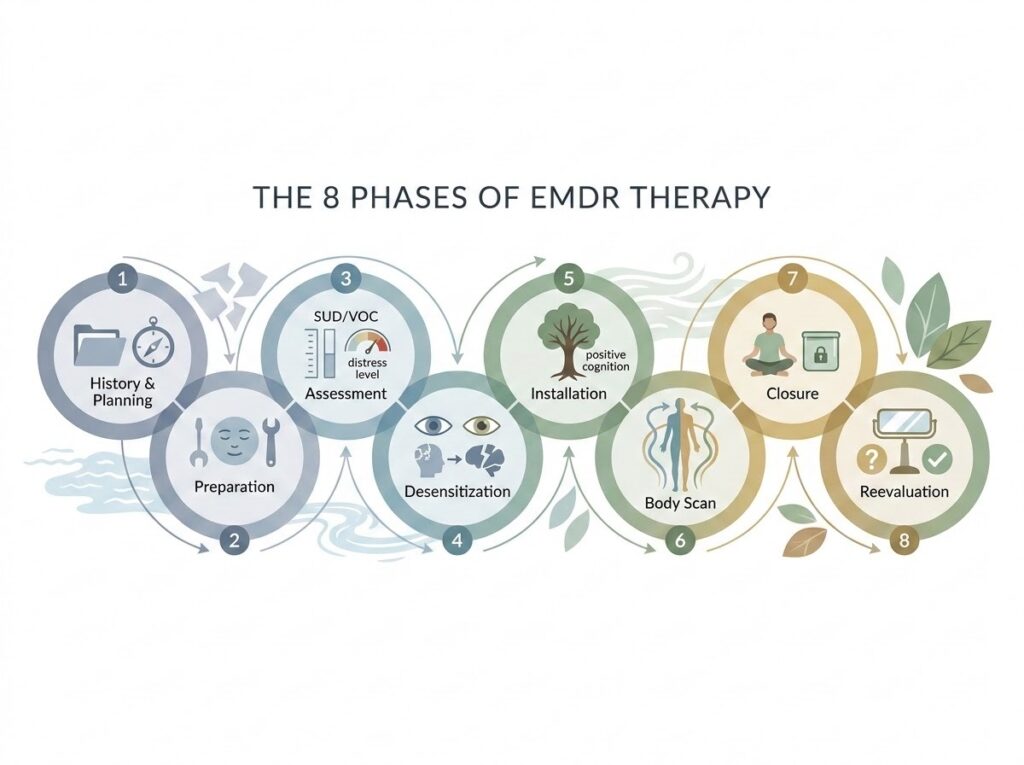
The 8 phases of EMDR therapy are: (1) history taking and treatment planning, (2) preparation, (3) assessment, (4) desensitization, (5) installation, (6) body scan, (7) closure, and (8) reevaluation. Each phase has its own purpose, and together they guide you from building safety to processing memories and reviewing progress.
The Eight EMDR Phases at a Glance
Phase 1 History Taking and Treatment Planning
Your therapist learns about your background, current concerns, and goals. Together, you begin identifying which memories or experiences may be worth focusing on.
Phase 2 Preparation
You and your therapist build trust and practice coping skills. Your therapist also explains what EMDR involves so you know what to expect.
Phase 3 Assessment
You identify a specific target memory, along with the negative belief, emotions, and body sensations connected to it. You’ll also rate how distressing the memory feels.
Phase 4 Desensitization
You focus on the memory while engaging in bilateral stimulation. The aim is to reduce how disturbing the memory feels.
Phase 5 Installation
You strengthen a more helpful, positive belief to replace the negative one connected to the memory.
Phase 6 Body Scan
You notice any remaining physical tension or discomfort while thinking of the memory and positive belief.
Phase 7 Closure
Your therapist helps you return to a calm, grounded state before the session ends.
Phase 8 Reevaluation
At the next session, you and your therapist review what’s changed and decide what to work on next.
Do All Eight Phases Happen in Every EMDR Session?
No. The phases don’t all happen in one session. Phases 1 and 2 may take one session or several, depending on your needs. Once reprocessing begins, a single session might include assessment, desensitization, and closure, while another might move through installation and the body scan.
Closure happens at the end of every reprocessing session, even if the memory isn’t fully processed yet. Reevaluation usually happens at the start of the following session. Your therapist will adapt the pace to you.
Phase 1. History Taking and Treatment Planning
Phase 1 is all about getting to know you. Your therapist wants to understand your story, your strengths, and what you’d like to feel differently. This phase shapes everything that comes after.
How Does an EMDR Therapist Assess Your History and Needs?
Your therapist will usually ask about your current concerns, past experiences, health history, relationships, and day-to-day functioning. They may ask what brought you to therapy now and what you hope will change.
You don’t have to share every detail right away. A trauma-informed therapist will let you set the pace and won’t push you to disclose more than you’re comfortable with. It’s okay to say, “I’m not ready to talk about that yet.”
How to Identify Targets in Standard EMDR Therapy and Treatment Goals
Together, you and your therapist look for patterns. Learning how to identify targets in standard emdr therapy is a key part of Phase 1. What situations trigger strong reactions today? What earlier experiences might be connected to those reactions?
From there, you’ll identify possible target memories. These are specific experiences you may focus on during reprocessing. Your therapist will also help you set treatment goals, like feeling calmer in certain situations or relating to yourself with less shame.
EMDR treatment plans often look at three time frames:
- Past memories that may be fueling current distress
- Present situations that trigger difficult reactions
- Future situations you’d like to handle with more confidence
Why Do Personal Resources and Readiness Matter?
EMDR can stir up strong emotions. That’s why your therapist will look at your current supports, coping skills, stability, and overall readiness before moving into memory work.
This isn’t a test you can pass or fail. It’s simply a way to make sure the process supports you rather than overwhelms you. If more stability is needed first, your therapist may spend more time on preparation, or suggest other approaches before or alongside EMDR.
Phase 2. Preparation for EMDR Therapy
It’s normal to feel nervous about revisiting painful memories. Phase 2 exists for exactly that reason. It helps you feel safer, more informed, and better equipped before reprocessing begins.
What Happens During the EMDR Preparation Phase?
During preparation, your therapist explains how EMDR works and what sessions will look like. You’ll talk through any worries or questions you have. You’ll also agree on a stop signal, like raising your hand, so you can pause at any point.
This phase is also about building trust. Feeling safe with your therapist matters. It’s one of the things that can help EMDR feel more manageable.
How Does a Therapist Help You Develop Coping Skills?
Your therapist will teach you practical tools to help you feel steadier when emotions run high. These skills are useful during sessions, between sessions, and in everyday life.
Grounding, calming, and emotional regulation strategies
Common tools include:
- Calm or safe place exercise: Picturing a place, real or imagined, that brings a sense of ease
- Breathing techniques: Slow, steady breaths to help settle your nervous system
- Grounding with your senses: Noticing what you can see, hear, or touch right now
- Container exercise: Imagining placing distressing thoughts in a secure container until your next session
Not every tool works for everyone. Your therapist will help you find what feels right for you.
Practicing ways to manage distress between sessions
You’ll practice these skills in session so they feel familiar when you need them. Your therapist may also suggest simple ways to use them at home, like a short breathing exercise before bed. The goal is to have a few go-to strategies in your back pocket.
How Do You Know If You Are Ready to Begin Reprocessing?
There’s no single sign that you’re ready. Generally, readiness may look like:
- Feeling reasonably safe and supported in your current life
- Being able to use at least a few coping skills when distress shows up
- Trusting your therapist enough to speak up if something doesn’t feel okay
- Understanding what EMDR involves and choosing to move forward
Your therapist will help you assess readiness together. It’s a shared decision, and you can always ask questions first.
Why Can Preparation Take More Than One Session?
For some people, preparation is fairly quick. For others, especially those with complex or long-term trauma, it may take several sessions or longer. That’s not a setback. It’s a sign that your therapist is building a steady foundation before moving ahead.
Remember: Going slower isn’t doing it wrong. A careful pace can support safer, more sustainable progress.
Phase 3. Assessment of the Target Memory
Phase 3 sets up the memory work. You and your therapist identify exactly what you’ll focus on and measure how distressing it feels right now. This gives you both a starting point to track change.
How Is a Target Memory Selected in EMDR?
The target memory usually comes from the treatment plan you created in Phase 1. Your therapist will ask you to bring up a specific image or moment that represents the memory, often the part that feels most upsetting.
You don’t have to describe the memory in great detail. You just need to be able to hold it in mind. Your therapist will also ask about the emotions and body sensations you notice when you think about it.
What Are Negative and Positive Cognitions in EMDR?
In EMDR, a cognition is simply a belief about yourself. You’ll identify two:
- Negative cognition: A belief connected to the memory that still feels true now. Examples include “I’m not safe,” “It was my fault,” or “I’m powerless.”
- Positive cognition: A belief you’d prefer to hold instead. Examples include “I’m safe now,” “I did the best I could,” or “I have choices.”
The positive belief doesn’t have to feel true yet. That’s okay. It’s just a direction to move toward.
How Do the SUD and VOC Scales Work?
EMDR uses two simple rating scales to track change. They help you and your therapist notice progress, even when it’s subtle.
Subjective Units of Disturbance (SUD): Rating distress
The SUD scale measures how disturbing the memory feels right now, from 0 to 10. Zero means no disturbance at all. Ten means the most disturbing you can imagine. There’s no right or wrong number. It’s simply your honest sense in the moment.
Validity of Cognition (VOC): Rating a preferred positive belief
The VOC scale measures how true your positive belief feels when you think about the memory, from 1 to 7. One means it feels completely false. Seven means it feels completely true. Many people start with a low number, and that’s completely normal.
Phase 4. Desensitization and Bilateral Stimulation

Phase 4 is often what people picture when they think of EMDR. It’s the main reprocessing phase. It can feel intense at times, but your therapist stays with you the whole way through.
What Happens During EMDR Desensitization?
You’ll bring the target memory to mind, along with the negative belief and body sensations. At the same time, your therapist will guide you through short sets of bilateral stimulation.
You don’t need to force anything. You just notice whatever comes up. That might be a thought, a feeling, an image, or nothing in particular. The goal is to let your brain process the memory naturally, with your therapist guiding the process.
Desensitization continues, often across multiple sessions, until the memory feels much less distressing. Ideally, the SUD rating comes down to 0 or close to it, though your therapist will consider what’s realistic for you.
What Is Bilateral Stimulation in EMDR Therapy?
Bilateral stimulation means stimulation that alternates between the left and right sides of your body. It’s a core part of EMDR. Researchers continue to study how it works, but it’s thought to help support memory processing.
Guided eye movements, alternating taps, and auditory tones
Bilateral stimulation can take several forms:
- Eye movements: Following your therapist’s fingers or a light bar as it moves side to side
- Tapping: Gentle alternating taps on your hands or knees, or handheld devices that pulse back and forth
- Auditory tones: Sounds that alternate between your left and right ears through headphones
You and your therapist can choose the method that feels most comfortable. Some methods work especially well for online sessions.
How the therapist checks in between sets of stimulation
Each set usually lasts somewhere from several seconds to under a minute. Afterward, your therapist will pause and ask something simple, like “What do you notice now?” You’ll share briefly, and then you’ll usually continue with another set.
These check-ins keep the process moving and help your therapist understand how you’re doing. You don’t need to explain everything in detail. A word or a short sentence is usually enough.
What Thoughts, Feelings, or Sensations Might Come Up During Reprocessing?
Everyone’s experience is different. During reprocessing, you might notice:
- Shifts in emotions, like sadness, anger, relief, or calm
- New details or different angles on the memory
- Related memories that seem connected
- Physical sensations, like tension, warmth, or tingling
- New insights or a change in how you see the situation
Sometimes it feels like not much is happening. Other times, it feels intense. Both can be part of the process.
In addition to EMDR, many clients benefit from exploring their inner parts and emotional system through Internal Family Systems (IFS) therapy.
What Happens If Distress Remains or New Memories Emerge?
It’s common for distress to go up before it comes down. If you feel stuck or overwhelmed, your therapist may change the type of stimulation, offer a gentle prompt, or pause to use a grounding skill.
If new memories come up, your therapist will help you decide whether to keep following them or to note them for later. You can always use your stop signal. You’re in control of the process, even when it feels hard.
Phase 5. Installation of Positive Beliefs
Once a memory feels less distressing, the focus shifts. Phase 5 is about strengthening a more helpful belief about yourself, one that fits who you are now.
What Does Installation Mean in EMDR Therapy?
Installation means linking your positive cognition to the target memory. Your therapist will ask you to think about the memory and the positive belief together, often while using more bilateral stimulation.
You’ll check whether the original positive belief still fits. Sometimes people find a version that feels more accurate after reprocessing. That’s perfectly fine.
What Are Examples of Positive Cognitions in EMDR?
Positive cognitions are personal. They should feel meaningful to you, not like a forced affirmation. Here are a few common themes.
Moving from self-blame toward self-compassion
Many people carry beliefs like “It was my fault” or “I should have done something.” Positive cognitions in this area might sound like:
- “I did the best I could with what I knew.”
- “It wasn’t my fault.”
- “I can learn from this without blaming myself.”
Strengthening beliefs about present safety, choice, or personal capability
Other beliefs focus on how you see yourself and your life today. Examples include:
- “It’s over, and I’m safe now.”
- “I have choices.”
- “I can handle what comes up.”
- “I’m worthy of care and respect.”
How Does the Therapist Assess Whether a Positive Belief Feels True?
Your therapist will use the VOC scale from Phase 3. You’ll rate how true the positive belief feels, from 1 to 7. Installation usually continues until the belief feels as true as it realistically can, often a 6 or 7.
If the number doesn’t move much, your therapist may explore what’s getting in the way. That may lead back to more processing. It’s not a failure. It’s useful information.
Phase 6. Body Scan and Remaining Physical Distress

Our bodies often hold onto stress in ways we don’t always notice. Phase 6 checks whether any physical tension is still connected to the memory you’ve been working on.
What Happens During the EMDR Body Scan?
Your therapist will ask you to hold the memory and the positive belief in mind. Then you’ll mentally scan your body from head to toe, noticing any tension, tightness, or unusual sensations.
If you notice something, you’ll let your therapist know. They may guide more bilateral stimulation while you focus on that sensation.
Why Does EMDR Include Body Sensations in Trauma Processing?
Distressing experiences can affect both mind and body. Some people notice physical reactions, like a tight chest or clenched jaw, when they think about a painful memory. The body scan helps check whether any of that reaction is still present.
That said, not every physical symptom is caused by trauma. Ongoing pain or health concerns deserve proper medical attention. The body scan is one part of EMDR, not a way to diagnose physical conditions.
What Happens If You Notice Tension or Discomfort During the Body Scan?
That’s okay and fairly common. Your therapist may use a few more sets of bilateral stimulation to help the sensation shift. Often, it eases. If it doesn’t, your therapist may explore whether it’s connected to another memory or something else entirely.
The phase is generally considered complete when you can think of the memory without noticeable physical distress.
Phase 7. Closure and Ending an EMDR Session Safely
You shouldn’t leave a session feeling stuck in the middle of something hard. Phase 7 makes sure each session ends with you feeling as steady and grounded as possible.
How Does an EMDR Therapist Help You Regain a Sense of Calm?
Before the session ends, your therapist will guide you through calming techniques. These are often the same skills you practiced in Phase 2, like breathing, a calm place exercise, or the container exercise.
Your therapist will also check in about how you’re feeling. The goal is for you to leave the session feeling settled enough to return to your day.
What Happens If a Target Memory Has Not Been Fully Processed?
It’s very common for a memory to need more than one session. If time runs short, your therapist will gently pause the reprocessing and move into closure. You’ll pick back up at the next session.
You might use the container exercise to set the memory aside for now. This isn’t about ignoring it. It’s about giving yourself permission to rest until you’re back in a safe, supported space.
What Should You Expect After an EMDR Session?
Processing can continue after a session ends. Some people feel lighter or more relaxed. Others feel tired, emotional, or a bit unsettled. Some don’t notice much at all. All of these responses can be normal.
Tracking emotions, memories, and reactions between sessions
Your therapist may ask you to keep a simple log. You might jot down:
- New memories, thoughts, or dreams
- Shifts in mood or emotions
- Moments when you felt triggered or noticed something different
You don’t need to analyze anything. Just notice and write it down. This can be helpful to review at your next session.
Using agreed-upon grounding strategies and contacting your therapist when needed
If something comes up between sessions, use the coping skills you’ve practiced. Rest, gentle movement, and basic self-care can help too. If distress feels like too much, reach out to your therapist using the plan you agreed on. If you ever feel unsafe, contact 988 or emergency services right away.
Phase 8. Reevaluation and Reviewing Treatment Progress
Phase 8 is a check-in on how things are going. It helps you and your therapist see what’s changed and decide what to focus on next.
What Happens at the Beginning of the Next EMDR Session?
Your therapist will usually start by asking how you’ve been since your last session. You’ll talk about anything you noticed, like new memories, dreams, emotions, or changes in how you’re reacting to triggers. Your log can be helpful here.
How Does a Therapist Assess Changes in Distress and Beliefs?
Your therapist will often ask you to bring up the target memory from last time. You’ll rate it again on the SUD scale. If you worked on installation, you may also rerate the positive belief on the VOC scale.
This shows whether the progress has held. Sometimes the memory feels just as calm as before. Sometimes a little distress has returned, which simply means there’s more to process.
When Does EMDR Move to Another Target Memory?
Generally, your therapist will move on when the current memory feels much less distressing, the positive belief feels true, and the body scan is clear. If there’s still work to do, you’ll return to the same memory first.
How Are Present Triggers and Future Challenges Addressed?
EMDR doesn’t stop at past memories. Once earlier memories have been processed, your therapist may focus on current triggers that still cause distress.
Then you may work on a future template. This means imagining an upcoming situation, like a difficult conversation, and practicing how you’d like to respond. It’s a practical way to build confidence for real life.
How Long Does EMDR Therapy Take, and What Affects the Timeline?
If you are wondering how long is emdr therapy or how long does emdr take to work, the honest answer is that it depends. EMDR doesn’t follow a one-size-fits-all schedule.
How Long Is a Typical EMDR Therapy Session?
Many EMDR sessions last between 60 and 90 minutes. Reprocessing sessions are sometimes longer than standard therapy sessions to allow time for setup, processing, and closure. Session length can vary by therapist, setting, and your needs.
How Many EMDR Sessions Might Someone Need?
Some people working on a single, specific event may notice changes in a relatively small number of sessions. Others, especially those with long-term or complex trauma, may work with EMDR for months or longer.
Neither path is better or worse. Your therapist can give you a rough sense of what to expect after getting to know you, but the timeline may shift as treatment moves along.
What Factors Influence the Pace of EMDR Treatment?
Several things can affect how quickly or slowly EMDR moves.
Personal history, treatment goals, and the complexity of distressing experiences
A single event often looks different from experiences that happened repeatedly or started early in life. The number of memories you want to address and the goals you set also play a role.
Readiness, available coping resources, and progress over time
If you need more time building coping skills, preparation may take longer. Life stress, health, support systems, and how processing unfolds from session to session can all affect the pace.
Does EMDR Follow the Same Timeline for Everyone?
No. Everyone processes experiences differently. Comparing your progress to someone else’s usually isn’t helpful. What matters is that the pace feels safe and supportive for you.
Bottom line: The right pace is the one that works for you, not the fastest one.
Choosing an EMDR Therapist and Getting Started

Finding the right therapist matters. EMDR should always be conducted by a qualified mental health professional who has completed proper training.
What Qualifications Should You Look for in an EMDR Therapist?
Look for a therapist who:
- Holds a mental health license, such as a licensed professional counselor, licensed clinical social worker, licensed marriage and family therapist, psychologist, or psychiatrist
- Has completed formal EMDR training, ideally through a program approved by EMDRIA (the EMDR International Association)
- Has experience with trauma and uses a trauma-informed approach
Some therapists are also EMDRIA Certified, which means they’ve completed additional training, consultation, and practice hours. Certification isn’t required to practice EMDR, but it can be a helpful sign of experience.
What Questions Should You Ask Before Starting EMDR?
It’s completely okay to ask questions before you commit. A good therapist will welcome them.
How do you assess readiness and adapt treatment to individual needs?
This question shows how carefully the therapist approaches preparation. Listen for whether they tailor the pace, build coping skills first, and adjust when something isn’t working.
How do you support clients between sessions?
Ask what happens if you feel distressed between appointments. Find out how to reach them, what their response time is, and what resources they recommend in a crisis.
You might also ask how much EMDR experience they have, what types of concerns they often work with, and how they handle sessions that feel overwhelming.
How Can Trauma-Informed Individual Therapy Support the EMDR Process?
EMDR often works alongside other forms of individual therapy. Trauma-informed therapy focuses on safety, choice, collaboration, and respect for your experience.
You might spend some sessions on EMDR and others talking through current challenges, building skills, or processing what’s coming up. This flexible approach can help EMDR feel more integrated into your overall care.
Where Can You Find In-Person or Online EMDR Therapy?
EMDR can be done in person or online. Where you can receive care depends on where you live and where your therapist is licensed.
Finding in-person EMDR support in Louisiana
If you’re in Louisiana, in-person EMDR may be an option with a licensed therapist trained in EMDR. Availability can depend on location, scheduling, and whether the therapist feels like a good fit for your needs. An initial consultation can help you figure that out.
Exploring eligible online therapy in Florida, Texas, or Nevada
Online EMDR may be available if you live in Florida, Texas, or Nevada. In general, therapists must be licensed in the state where you’re physically located during your session. So eligibility depends on your location, the therapist’s licensure, and whether online care is clinically appropriate for you.
How Can You Take the Next Step Toward EMDR Therapy?
You don’t have to have everything figured out to reach out. A simple first step is scheduling a consultation with a licensed, EMDR-trained therapist. Use that time to ask questions, share what you’re hoping for, and see how it feels to talk with them.
Remember, EMDR is one option among many. A good therapist will help you explore whether it fits your needs, and they’ll be honest if another approach might be a better starting point.
Ready to begin your healing journey? Visit Gift of Counseling to learn more about our practice or schedule a free consultation today.
Frequently Asked Questions About the 8 Phases of EMDR Therapy
Do You Have to Talk About Trauma in Detail During EMDR?
Not usually. EMDR doesn’t require you to describe a memory in full detail. You’ll need to share enough for your therapist to understand the target, but much of the processing happens internally. You can share as much or as little as feels right.
Can You Pause or Stop EMDR During a Session?
Yes. You’ll agree on a stop signal before reprocessing begins. You can use it anytime. Your therapist will help you pause, ground yourself, and decide together what to do next.
Is EMDR Safe, and Are There EMDR Therapy Side Effects?
People often ask “is emdr safe?” When guided by a qualified therapist, EMDR is widely considered a safe treatment option. However, like any therapy, there can be emdr therapy side effects, such as feeling tired, emotional, or temporarily unsettled after a session. Planning for gentle downtime can help as your brain processes the work.
Can EMDR Help With Trauma That Happened Years Ago?
It may. Many people use EMDR to work through memories from years or even decades ago. Results vary from person to person, so it’s best to talk with a qualified therapist about your specific experiences and goals.
Is EMDR the Same as Traditional Talk Therapy?
No. Talk therapy mostly focuses on discussing thoughts, feelings, and experiences. EMDR uses a structured eight-phase process and bilateral stimulation to help process distressing memories. Many therapists use both, depending on what you need.
Can You Complete EMDR Therapy Online?
In many cases, yes. Therapists can adapt bilateral stimulation for video sessions using on-screen visuals, self-tapping, or audio tones. Online EMDR may not be right for everyone, though. Your therapist will consider your safety, privacy, and comfort, along with state licensure rules.
How Do You Know Whether EMDR Is Right for You?
There’s no quick quiz for this. EMDR may be worth exploring if past experiences still affect how you feel, think, or react today. The best way to know is to talk with a licensed, EMDR-trained therapist who can review your history, goals, and readiness. They can help you decide whether EMDR, another approach, or a combination makes the most sense for you.
Understanding the 8 phases of EMDR therapy won’t answer every question, and it doesn’t have to. It’s just a starting point. When you’re ready, the next step is a simple, honest conversation with a professional who can help you move forward at your own pace.