

Have you ever caught yourself reacting in a way that felt entirely out of character? Perhaps you snapped at a loved one over a minor mistake, lost two hours endlessly scrolling when you desperately needed rest, or replayed an awkward moment in your head until sunrise. In the aftermath of those moments, it is entirely natural to feel frustrated and wonder why staying in control feels so difficult.
The Internal Family Systems (IFS) model offers a far gentler, more revealing lens. Rather than viewing these reactions as character flaws or symptoms to eradicate, IFS recognizes them as the voices of distinct internal “parts.” Crucially, every single one of those parts is attempting—in its own unique, often outdated way—to protect you.
This guide moves beyond clinical jargon to offer genuine insight into how your internal ecosystem works. We will explore the origins of IFS, the roles your inner parts play, how therapy helps restore self-leadership, and practical steps for finding a skilled IFS practitioner in Florida. If you are ready for tailored clinical support, explore individual therapy with Gift of Counseling to begin cultivating a deeper relationship with yourself.
Please note: This article is provided for educational purposes and is not a substitute for clinical evaluation or treatment. If you are experiencing a mental health crisis or thoughts of self-harm, please call or text 988 immediately to connect with the Suicide & Crisis Lifeline.
What Is the Internal Family Systems Model?
Developed as an integrative approach to psychotherapy, Internal Family Systems rests on a ground-breaking premise: the human mind is naturally sub-divided into multiple sub-personalities, or “parts.” Much like members of a complex family system, these parts interact, form alliances, clash, and take on specialized roles to navigate life’s challenges.
Some aspects of you may be ambitious and driven, while others feel anxious or exhausted. Learn how Internal Family Systems therapy facilitates compassionate dialogue with these internal voices, reconnecting you with an undamaged, centered core known as the Self.
When clients ask what sets IFS apart from traditional talk therapy, the answer lies in its non-pathologizing foundation. Rather than framing inner conflict as a psychological defect, IFS treats multiplicity as a normal, healthy feature of human consciousness. If you have ever felt pulled in two opposing directions at once, you have already experienced the reality of inner parts.
How IFS Maps the Human Psyche
In everyday conversation, we naturally use parts-based language without realizing it: “A part of me wants to take this career leap, but another part is terrified of failure.” IFS validates this intuitive self-knowledge and provides a structured framework for working with those internal dynamics.

Instead of forcing yourself to conform to a single mindset, IFS invites you to welcome every internal aspect into the conversation, unlocking genuine internal collaboration.
Understanding Your Inner Sub-Personalities
In the IFS framework, each part possesses its own unique beliefs, emotional triggers, memories, and protective motivations. Common examples include:
A relentless achiever that ties your worth to productivity and perfection.
- An anxious watcher hyper-vigilant for signs of social rejection.
- A protective numbing response that seeks immediate escape through distractions or comfort habits.
- A vulnerable inner aspect holding unresolved hurts or shame from early childhood.
- Recognizing these internal entities is not a sign of fragmentation; it is an avenue toward self-awareness and healing.
Having parts doesn’t mean you have multiple personalities or a disorder. It’s an everyday human experience. Most of us just don’t stop to notice it.
The Principle of Positive Intention
One of the most transformative insights of the IFS model is its core tenet: there are no bad parts. Even behaviors that feel self-destructive—such as harsh self-criticism, chronic avoidance, or sudden outbursts—stem from protective intentions.
These protective parts often stepped into demanding roles during times of emotional vulnerability, utilizing whatever strategies were available back then. When you shift from self-judgment to genuine curiosity, the internal battle softens, opening space to understand what those parts truly fear.
By meeting your protective system with appreciation rather than resistance, you lay the groundwork for long-term internal trust.
The Evolution of IFS in Clinical Practice
IFS was created in the 1980s by Dr. Richard Schwartz, a systemic family therapist. While working with clients struggling with severe eating disorders and trauma, Dr. Schwartz observed that clients consistently spoke about distinct internal voices or parts that interacted in structured, predictable ways.
Applying systems theory internally, he discovered that when parts felt acknowledged and agreed to step back slightly, clients naturally embodied an innate state of calm, clarity, and wisdom—what Dr. Schwartz identified as the Self.
Today, the IFS Institute offers rigorous training worldwide. The model is widely utilized across individual psychotherapy, couples counseling, trauma recovery, and personal development programs.
While introductory books and workbooks serve as valuable educational entry points, working alongside a certified therapist remains the gold standard for navigating complex trauma and deep emotional unburdening.
Core Foundations of the Model
Three fundamental pillars anchor the practice of Internal Family Systems therapy:
1. An Undamaged Core Core Self
Every individual possesses an essential Self characterized by balance, wisdom, and resilience. This core cannot be damaged by trauma or life hardships; it merely becomes obscured when protective parts take over focus.
Healing is therefore not a matter of fixing what is broken, but of restoring access to this inherent wisdom.
2. Protective Intention Behind Every Behavior
Regardless of how dysfunctional an internal pattern may seem, its underlying motive is safety. A perfectionist manager attempts to shield you from disapproval, while an angry protector guards against feeling vulnerable.
The behavior might cause problems. The intention usually doesn’t come from a bad place.
3. Integration Through Relational Understanding
Attempting to force unwanted habits into submission almost always backfires. True transformation happens when parts feel understood, validated, and assured that the Self can lead effectively.
IFS takes a different path. Instead of suppressing parts, you get to know them. When parts feel heard, they often relax on their own. That’s where real change tends to start.
Mapping the Internal System: The Self and the Three Categories of Parts
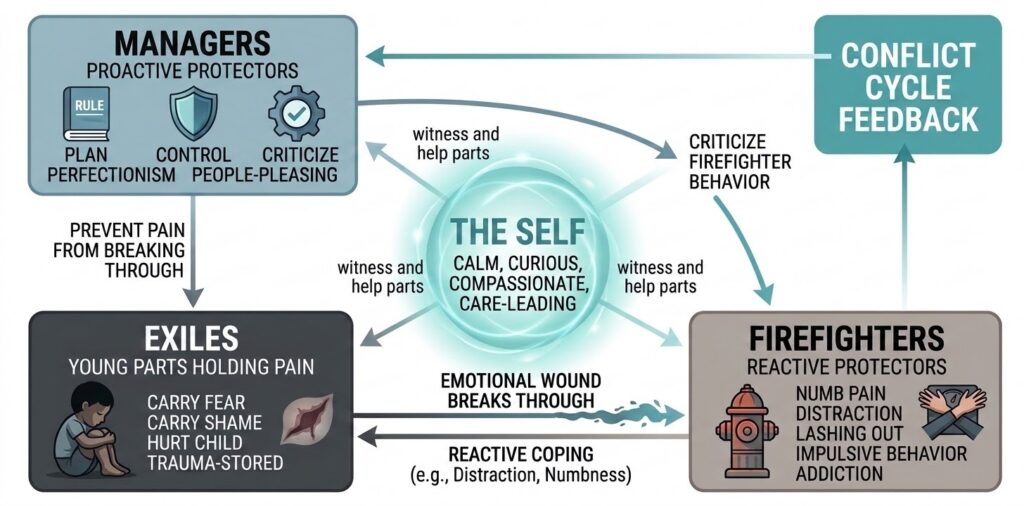
To navigate your internal landscape, IFS categorizes parts into three distinct functional roles: Managers, Exiles, and Firefighters. At the center of this dynamic network resides the Self.
The Essence of Self-Leadership
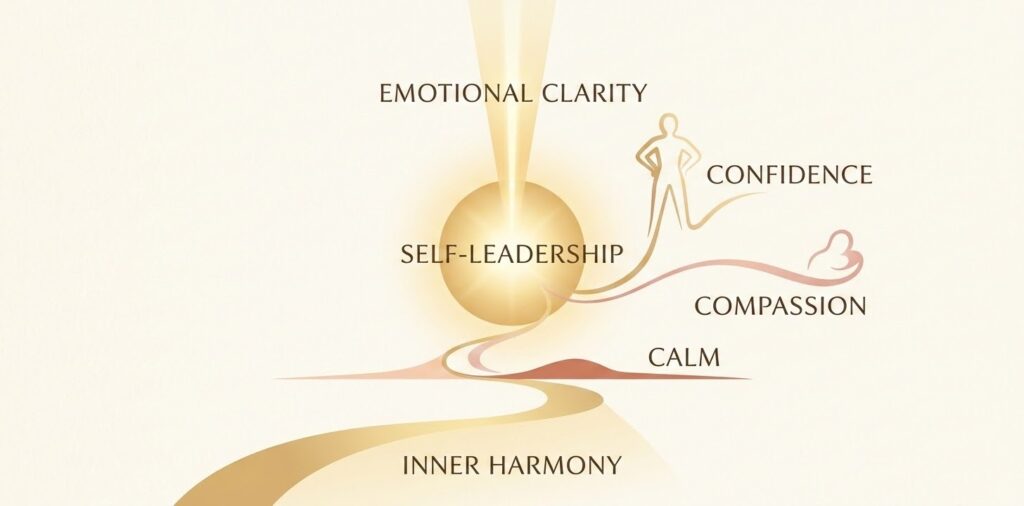
The Self is not a part; it is your fundamental essence—the conscious, grounded presence capable of observing internal thoughts and emotions without becoming overwhelmed by them. When operating from Self, you meet life’s difficulties with grounded discernment rather than reactive defense.
When you’re in Self, you can look at a painful feeling and say, “Oh, that makes sense,” instead of “What’s wrong with me?” You can sit with your own pain the way a kind friend would.
The 8 Cs of Self-Energy
In IFS literature, the presence of Self-energy is characterized by eight natural qualities:
- Calm: Inner stability amidst emotional turbulence.
- Curiosity: An open, non-judgmental desire to understand internal experience.
- Clarity: Objective perception unclouded by emotional distortion.
- Compassion: Deep empathy for your own suffering and that of others.
- Confidence: Grounded trust in your capacity to handle challenges.
- Courage: Willingness to face painful realities and set healthy boundaries.
- Creativity: Flexibility and fresh perspective in problem-solving.
- Connectedness: A felt sense of relational harmony with yourself and the world.
You do not need to embody all eight qualities simultaneously; even a subtle spark of curiosity or compassion indicates that Self-energy is accessible.
Recognizing Self-Leadership in Daily Life
When a protective part takes over, physical signals often follow: physical tension, a racing pulse, or intense emotional urgency. Conversely, responding from Self feels spacious and balanced.
You can tell Self is present when you notice feelings without being consumed by them, listen to opposing views without defensiveness, and offer genuine warmth to your own struggles.
- You’re curious about a feeling instead of afraid of it
- You can see more than one side of a situation
- You feel kind toward yourself, even when you’ve made a mistake
- Your body feels a little more relaxed
This isn’t about being perfectly calm all the time. It’s just about having a bit more room inside.
1. Managers: Proactive Protectors
Managers run the day-to-day operations of your life. They work preemptively to maintain control, minimize risk, and prevent vulnerable emotions from breaking through into awareness.
While managers perform essential functions like planning and organizing, they can become rigid and exhausting when working in overdrive.
Common Manager Strategies
Familiar manager patterns include relentless perfectionism, chronic over-analyzing, people-pleasing, and an active inner critic designed to police your actions before others can judge you.
- Perfectionism: A part that believes if everything is flawless, nobody can criticize you
- People-pleasing: A part that keeps others happy so you won’t be rejected or left alone
- Overthinking: A part that tries to predict every possible problem so you’re never caught off guard
- The inner critic: A part that judges you harshly, often to push you before someone else can
These parts aren’t the enemy. They’re tired workers doing a hard job. IFS helps you thank them and find out what they’re protecting.
2. Exiles: The Vulnerable Burden-Carriers
Exiles are the young, wounded parts that hold painful memories, fears, or beliefs stemming from earlier life trauma, rejection, or emotional neglect.
Because their pain feels overwhelming to the rest of the system, protective managers lock exiles away in the internal basement to keep you functioning.
The Weight of Emotional Burdens
Exiles carry deep burdens such as “I am unlovable,” “I am unsafe,” or “I am a burden to others.” When triggered, their intense pain can flood your system, causing sudden feelings of worthlessness or panic that seem disproportionate to the current situation.
When an exile gets stirred up, you might suddenly feel small, panicky, or deeply sad — even if the current situation doesn’t seem to match. That’s often a sign an old wound has been touched.
Exiles aren’t broken. They’re hurting, and they’re waiting for someone to notice them with care.
3. Firefighters: Reactive Responders
When preventative managers fail and an exile’s pain erupts, firefighters react instantly. Their sole objective is to douse the emotional fire by any means necessary, showing little concern for long-term consequences.
Recognizing Firefighter Impulses
Firefighter responses manifest as impulsive or numbing behaviors: binge eating, substance use, sudden explosive anger, dissociation, excessive spending, or self-harming urges. Understanding the protective urgency behind these reactions is the first step toward introducing healthier coping strategies.
- Binge-watching, binge-eating, or scrolling for hours
- Drinking or using substances
- Sudden anger or lashing out
- Dissociating, zoning out, or going numb
- Impulsive spending
- Self-harm
Some of these can be risky, and it’s important to get support if they’re putting you in danger. IFS doesn’t excuse harmful behavior. It just helps you understand the protective job behind it — which often makes real change more possible than shame ever could.
The Internal Conflict Cycle
Without Self-leadership, parts often lock into painful internal cycles. A manager pushes you to overwork; exhaustion triggers an exile’s hidden loneliness; a firefighter steps in with excessive screen time to numb out; and the manager responds with harsh self-condemnation. IFS therapy interrupts this cycle by cultivating internal harmony.
- An exile carries old pain — like a belief that you’re not good enough.
- Managers work hard to keep that pain from surfacing, maybe by pushing you to overachieve.
- Something happens — like harsh feedback at work — and the exile’s pain breaks through.
- Firefighters jump in to numb the pain, maybe with a night of drinking or hours of scrolling.
- Managers then criticize you for the firefighter behavior, and the cycle starts again.
Managers and firefighters often clash, and you get caught in the middle. IFS helps calm that conflict by getting to know each part — and, eventually, caring for the exile they’re both protecting.
The Experience of Internal Family Systems Therapy
IFS therapy is an experiential, collaborative process. Rather than analyzing behavior from a distance, your therapist guides you to turn inward, helping you build direct, respectful relationships with your inner system at a pace that honors your safety.
Inside a Clinical Session
A typical session begins by identifying a present-day stressor or emotional pattern. With your therapist’s guidance, you slow down and direct mindful attention inward to discover which parts are active around that issue.
Some people close their eyes and turn inward. Others prefer to keep their eyes open and just talk. Either way is fine. There’s no right way to do this.
The 6 Fs Process
Practitioners often utilize the “6 Fs” framework to help clients connect with protective parts safely:
- What are you feeling right now?
- Where do you notice that in your body?
- Is there a thought or image that goes with it?
1. Find: Locate the part’s presence in or around your body.\n2. Focus: Turn your attention fully toward it.n3. Flesh out: Observe its feelings, age, visual appearance, or physical sensations.\n4. Feel toward: Assess how you feel toward the part (checking for Self-energy).\n5. Befriend: Learn about its protective job and positive intent.\n6. Fears: Ask what it fears would happen if it stepped down from its role.
Many IFS therapists use a simple sequence sometimes called the 6 Fs: find the part, focus on it, flesh it out, notice how you feel toward it, befriend it, and ask about its fears. It’s one of the most accessible internal family systems therapy techniques for getting started.
Developing Curiosity and Compassion Toward a Part
Once you’ve found a part, your therapist will ask how you feel toward it. This question matters a lot.
If you feel annoyed, scared, or judgmental, that’s usually another part stepping in. Your therapist might ask that part to give you a little space. When you can feel some curiosity or compassion, that’s a sign Self is present.
From there, you can ask the part questions. What does it want you to know? What’s it worried would happen if it stopped doing its job? It’s a little like sitting with a nervous friend and just listening.
The Technique of Unblending
“Blending” occurs when a part’s emotions overwhelm your consciousness, making you feel as though you are the emotion. Unblending gently separates your core Self from the part, allowing you to observe and comfort the emotion rather than being consumed by it.
Unblending means creating a bit of space between you and the part. It’s the difference between being caught in a wave and watching it from the shore.
Your therapist might help you unblend by asking you to notice where the part is in your body, imagine it sitting across from you, or simply ask it to step back a little. Unblending doesn’t mean pushing a part away. It just means you can see it clearly enough to help it.
The Unburdening Protocol
Once protective parts trust the Self and grant permission, the therapist facilitates the unburdening of an exile. This structured sequence involves witnessing the exile’s past pain, retrieving it from historical memories into present safety, releasing emotional burdens, and integrating new vitality into the system.
Unburdening is central to IFS healing. It’s the process of helping a part let go of that load, and it often includes steps like:
- Witnessing: The part shows you what happened and how it felt, and you really listen
- Retrieval: You help the part leave the painful past and come into the present, where it’s safer
- Release: The part lets go of the burden, sometimes by imagining giving it to light, water, fire, or earth
- Invitation: The part is invited to take in new qualities it may need, like playfulness or confidence
- Integration: Protective parts check in and notice they may not have to work so hard anymore
This can sound a little unusual at first, and that’s okay. Many people find it feels more natural once they experience it.
Pacing and Systemic Consent
A skilled IFS clinician never bypasses protective managers to force access to deep wounds. Respecting protective boundaries ensures that healing proceeds safely without triggering severe emotional backlash.
So therapy often starts with managers and firefighters. You get to know them, thank them, and address their fears. Only when they give permission does the work move toward exiles. This keeps the process respectful and helps prevent overwhelm.
Why Trauma Processing Should Follow the Client’s Readiness and Pace
There’s no prize for going fast. Moving too quickly into painful material can leave you feeling flooded or worse off than before.
In trauma-informed IFS, you set the pace. You can slow down, pause, or say “not today” at any point. A skilled therapist watches for signs that protective parts are getting nervous and treats that as useful information — not resistance to push through.
What Is the Difference Between Self-Led Healing and Trying to Control Your Emotions?
A lot of us have learned to manage feelings by gritting our teeth. Don’t cry. Don’t get angry. Just push through. That kind of control usually comes from manager parts, and it can be exhausting.
Self-led healing is different. This isn’t about controlling your emotions. It’s about relating to them.
When you lead from Self, you don’t need to force a part to change. You listen, you understand, and the part often softens because it finally feels safe. It’s less like wrestling and more like building trust with someone who’s been on guard for a long time.
IFS as a Trauma-Informed Approach
Trauma freezes internal parts in past moments of danger. IFS provides a gentle, effective pathway for trauma recovery by restoring internal safety and helping traumatized parts realize that the past trauma is over.

For comprehensive trauma resolution, many individuals benefit from integrating IFS with bodily-focused modalities like EMDR therapy.
Addressing Triggers and Developmental Wounds
Present-day triggers act as alarms from exile parts signaling that an old wound has been touched. IFS enables you to trace these reactions back to their origins, helping childhood parts receive the validation, protection, and care they lacked at the time.
Because Self stays present throughout, you’re witnessing your own experience from a place of care — instead of reliving it alone. Many people find that makes painful memories feel more manageable.
Understanding the Connection Between Past Experiences and Present Triggers
Sometimes a small moment sets off a huge reaction. A partner’s sigh feels like rejection. A boss’s short email feels like you’re about to be fired.
IFS helps you trace those reactions back to the parts involved. Often, an exile from an earlier time is being touched, and protectors are rushing in. Seeing that connection doesn’t erase the reaction overnight, but it can make it feel a lot less confusing — and a lot less like a personal failing.
Working With Shame, Fear, and Vulnerable Inner Parts
Shame tends to hide. It tells us we’re the problem and that nobody should see what’s inside.
IFS meets shame with compassion. When a vulnerable part shares its fear or shame and is met with kindness instead of judgment, that part can start to feel less alone. Over time, the belief that “something’s wrong with me” can loosen into “something hard happened to me.”
Can IFS Help With Childhood Emotional Wounds?
Many people seek IFS because of childhood experiences. That might include big events like abuse or neglect, or quieter wounds like feeling unseen, criticized, or responsible for adults’ feelings.
Internal family systems exiles often carry the feelings of the child you once were. IFS gives you a way to go back and offer those parts the care, comfort, or protection they didn’t get at the time. It can’t change what happened, but it can change how those parts carry it today.
How Can IFS Help You Understand Emotional Triggers and Protective Responses?
Instead of asking “Why do I always overreact?” IFS invites a gentler question: “Which part of me just showed up, and what’s it trying to protect?”
That small shift can make a big difference. When you know your parts, you start to recognize patterns. You might notice your people-pleasing part kicks in around certain family members, or that a firefighter part takes over after stressful days. Knowing this gives you more choice in how you respond.
Why Safety, Stabilization, and Trust Matter in Trauma-Informed IFS Therapy
IFS healing from trauma depends on feeling safe — safe with your therapist, safe in your body, and safe enough inside that protective parts can relax a bit.
Trauma-informed IFS usually focuses on:
- Safety: Building a relationship where you feel respected and in control
- Stabilization: Making sure you have support and coping tools before going into deep material
- Trust: Letting protectors decide when they’re ready, rather than pushing past them
This foundation isn’t a delay. It’s what makes deeper healing possible.
Clinical Applications of Internal Family Systems
IFS is an versatile evidence-based modality used to treat a broad spectrum of mental health challenges, including:
Anxiety and Chronic Worry
Anxiety often reflects overworked manager parts attempting to anticipate every possible catastrophe. IFS helps soothe these vigilant protectors by grounding them in present reality.
IFS helps you get to know these anxious parts and ask what they’re afraid of. Often, they’re protecting a vulnerable exile. As that exile gets care, the anxious parts may not need to work as hard.
Depression and Inner Criticism
Depressive states often involve heavy shutdown parts or severe self-critical managers. IFS builds compassionate relationships with these parts, helping relieve internal oppression.
Self-criticism is a common target in the inner family system. When you understand why your critic talks to you the way it does, you can start building a different relationship with it. Depression can be serious, so IFS is often one part of a broader care plan that may include medical support.
Trauma and Complex PTSD
Its non-pathologizing approach makes IFS uniquely suited for trauma recovery, allowing clients to process traumatic material without experiencing retraumatization.
That said, PTSD treatment should be guided by a licensed professional who can assess your needs and talk through all your options.
IFS for Shame, Perfectionism, and People-Pleasing
These patterns are where IFS often shines. Perfectionism and people-pleasing are classic manager behaviors, and shame is often carried by exiles.
IFS helps you see these patterns as protective strategies instead of personality flaws. That alone can bring a lot of relief.
Relational Patterns and Conflict
When partners trigger each other’s protective parts, relationship dynamics deteriorate rapidly. Exploring specialized couples therapy helps partners identify their internal parts and communicate from a place of shared Self-energy.
IFS helps you notice which parts show up in your relationships. When you can lead from Self, you’re more likely to respond than react. If relationship patterns feel stuck, discovering specialized couples therapy can help both partners understand their own parts — and each other’s.
Is IFS Appropriate for Everyone, or Might Another Approach Be More Suitable?
IFS can be helpful for many people, but it isn’t the best fit for every situation. Some people find that other approaches — or a combination of methods — work better for them. If you’re unsure, a good therapist will talk through your options honestly.
Evaluating IFS: Benefits, Evidence, and Considerations
While IFS is an effective and deeply empowering model, understanding both its strengths and limitations helps ensure it is the right fit for your mental health goals.
Key Therapeutic Advantages
IFS fosters profound self-compassion, reduces inner shame, equips clients with sustainable self-soothing tools, and creates lasting internal harmony.
One of the most consistent things people describe after working with IFS is a gentler relationship with themselves. When you understand that even your most difficult patterns started as protection, it’s harder to hate yourself for having them.
Understanding Protective Behaviors and Conflicting Feelings
IFS gives you a framework for making sense of why you do things that seem to work against you. That understanding can be genuinely useful, not just in therapy, but in daily life.
Building Healthier Relationships With Yourself and Others
When parts aren’t running the show on autopilot, you tend to have more room for real connection — with yourself and with people you care about.
Clinical Considerations and Limitations
IFS requires a willingness to engage in introspective, imagery-based inner work, which may feel abstract initially. Additionally, finding certified practitioners can require patience, and the model may be supplemented with cognitive-behavioral techniques when immediate skill-building is required.
- IFS can feel abstract or unfamiliar at first. Some people struggle to connect with the “parts” framework.
- It tends to be slower-paced than approaches like cognitive behavioral therapy (CBT), which can be a drawback if you’re looking for fast, structured skill-building.
- Finding a well-trained IFS therapist can take time, especially in areas where certified practitioners are limited.
- There is internal family systems therapy criticism around the relatively limited volume of large-scale clinical research supporting it, compared to more established models like CBT.
- Some practitioners and researchers have raised questions about internal family systems therapy controversy — specifically around how the model is trained and marketed, and whether its claims are fully supported by the current evidence base. These are fair questions to hold, and a good therapist will welcome them.
Criticism doesn’t mean the model doesn’t work. It means you should go in with realistic expectations — and that your therapist should be honest about what IFS can and can’t do.
The Evidence Base for IFS
Recognized on the National Registry of Evidence-Based Programs and Practices (NREPP), empirical research demonstrates that IFS significantly reduces symptoms of PTSD, depression, and anxiety while enhancing overall emotional well-being.
What Does Current Research Say About IFS and Trauma?
Research on IFS therapy for trauma is growing. Studies suggest it can reduce PTSD symptoms, decrease shame, and improve emotional regulation. IFS has also been studied in the context of chronic illness, eating disorders, and anxiety.
However, many of these studies are small, and more large-scale randomized controlled trials are needed before broad clinical conclusions can be drawn.
Why More Large-Scale Clinical Research Is Needed
The honest answer is that IFS is relatively young as a formalized therapy model, and research takes time and funding. The evidence so far is encouraging but not yet as robust as it is for CBT or EMDR. A good IFS therapist will tell you this rather than oversell it.
What Should You Know About Emotional Intensity During Trauma-Focused Therapy?
Trauma work — in any model — can bring up strong feelings. Parts that have been exiled for a long time may need to be heard before they settle.
This is normal, and it doesn’t mean something is going wrong. It does mean you need a therapist who knows how to pace the work, check in with your protective parts, and make sure you feel stable between sessions. If things feel too intense, you can always slow down.
Comparing Therapeutic Modalities
IFS and EMDR
While EMDR uses bilateral stimulation to reprioritize traumatic memory storage in the brain, IFS focuses on building internal relationships with the parts holding those memories. Combining both provides an exceptionally integrative trauma protocol.
IFS works differently. Rather than targeting memories directly, it approaches the parts that hold those memories. IFS tends to be a longer process, but many people find it also shifts how they relate to themselves — not just how they store a memory.
Some therapists use both, blending IFS’s relational framework with EMDR’s memory processing. That combination can work well for people with complex trauma histories.
IFS and Cognitive Behavioral Therapy (CBT)
CBT works primarily at the cognitive level to modify irrational thoughts and actions. In contrast, IFS addresses the emotional root of thoughts by asking which part holds the belief and why, offering depth-oriented resolution.
IFS works at a different level. Rather than changing a thought directly, it asks where that thought is coming from and what part is holding it. This can feel more intuitive for people who find that knowing something is irrational doesn’t stop them from feeling it.
CBT and IFS aren’t mutually exclusive. Some therapists draw on both, depending on what you need.
Can IFS Be Combined With Other Trauma-Informed Therapies?
Yes. IFS is often used alongside somatic approaches, narrative therapy, mindfulness-based practices, and EMDR. The relational and parts-based framework of the inner family system can complement other models well, especially for complex or developmental trauma.
How Do You Decide Which Therapy Approach Fits Your Needs?
A few things worth thinking about:
- Do you want a structured, skills-based approach (CBT) or something more exploratory and relational (IFS)?
- Are you dealing with specific traumatic memories or more diffuse emotional patterns?
- How do you feel about working with concepts like “parts” and the Self? Does that language resonate or feel off-putting?
There’s no single right answer. The best therapy is often the one you’ll actually engage with — and the one offered by a therapist you trust.
Practical Investment and Duration
Therapy Costs and Insurance
Fees for specialized IFS therapy vary based on practitioner experience, regional location, and licensure. Many specialized practices operate on an out-of-network basis, providing superbills for insurance reimbursement.
Individual Therapy Fees, Insurance, and Out-of-Pocket Costs
In the US, individual therapy sessions typically range from $100 to $250 per hour, though this varies widely. Some IFS therapists accept insurance — check with your provider about mental health coverage. Others work on a sliding scale if cost is a barrier.
Treatment Length and Pace
Therapy duration depends on your individual goals and internal complexity. Some clients experience meaningful internal shifts in a few months, while resolving complex trauma systems often involves longer-term care.
IFS isn’t usually a short-term, quick-fix model. If you’re looking for brief, structured support, CBT or a solution-focused approach might be a better starting point. IFS tends to go deeper, which takes more time.
What Factors Can Affect the Pace of Progress in IFS Therapy?
Progress in IFS depends on things like:
- The complexity and nature of what you’re working on
- How much your protective parts trust the process (and the therapist)
- The consistency and frequency of sessions
- Your life outside of therapy — including stress levels, support, and stability
Slower progress isn’t failure. Sometimes it means protective parts need more time, which is completely valid.
Does Online IFS Therapy Differ From In-Person Sessions?
The core process is the same. Many people do meaningful IFS work via video sessions. The main difference is the absence of physical presence, which can matter for some people — particularly when body awareness is central to the work.
If you’re in Florida and prefer remote options, many South Florida therapists offer telehealth. Some people do a mix of in-person and online sessions depending on the week.
Finding an IFS Therapist in Florida
Credentials to Look For
When seeking a practitioner in South Florida or online via telehealth, verify that your clinician holds active state licensure (LMHC, LCSW, LMFT, or Licensed Psychologist) alongside formal Level 1, 2, or 3 training from the IFS Institute.
Understanding IFS Training, Certification, and Professional Licensure
The IFS Institute offers a tiered training program. Therapists can complete Level 1, 2, or 3 training. Some pursue IFS certification, which requires additional supervised hours. Look for a licensed mental health professional — LCSW, LMFT, licensed psychologist, or licensed counselor — who has completed at least Level 1 IFS training.
In Florida, you can verify licensure through the Florida Department of Health’s practitioner search tool. This is separate from IFS training, but both matter.
What Questions Should You Ask Before Starting IFS Therapy?
Some simple ones worth raising:
- What IFS training have you completed?
- Have you worked with clients dealing with similar concerns to mine?
- How do you pace trauma work and check in with protective parts?
- What does a typical session look like with you?
- Do you work with other approaches alongside IFS?
A good therapist will welcome these questions without hesitation.
How Can You Tell Whether an IFS Therapist Is a Good Fit for You?
The relationship matters as much as the model. You want someone who:
- Listens without rushing to fix
- Makes you feel safe enough to go slowly
- Respects your pace and your protectors
- Doesn’t push you toward material you’re not ready for
- Is honest about what IFS can and can’t do
It’s okay if the first therapist isn’t quite right. Finding a good fit can take a few tries, and that’s normal.
What Should You Expect From an Initial IFS Therapy Consultation?
Most therapists offer a short initial consultation — sometimes free, sometimes a reduced-fee first session. Use it to get a feel for how they work, ask your questions, and notice how you feel talking to them.
You don’t have to commit after one conversation. You’re allowed to take your time.
Taking the Next Step
Schedule an initial consultation to discuss the clinician’s background, ask how they navigate protective parts, and ensure you feel comfortable in their presence as you embark on your journey toward self-leadership.
- The IFS Institute’s therapist directory at ifs-institute.com
- Psychology Today’s therapist finder, filtered by specialty and location
- Your insurance company’s provider portal, filtered for trauma-informed or IFS-trained therapists
- Asking a primary care provider or trusted contact for a referral
Whether you’re in Miami, Fort Lauderdale, Boca Raton, West Palm Beach, or the surrounding areas, IFS-trained therapists are available — both in person and via telehealth.
Frequently Asked Questions
How does IFS therapy help with past trauma?
IFS helps heal trauma by establishing safe internal relationships between your grounded Self and the parts holding historical pain, enabling them to safely release emotional burdens without overwhelming your daily life.